
-
Total Likes
Like
- View 1160
- Last Updated 15 Jul, 2025
Brain Teasers
-
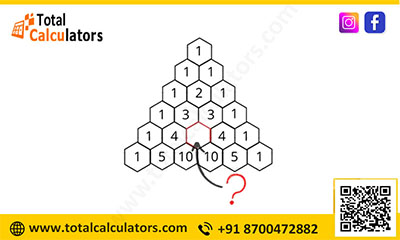
Ye figure Pascal का त्रिभुज है — हर संख्या अपने ऊपर की दो बराबर लगने वाली संख्याओं का योग होती है:
C(n,k)=C(n−1,k−1)+C(n−1,k). -
दी गई पंक्ति है 1, 5, 10, 10, 5, 1 यह n=5 की पंक्ति है।
-
अगली पंक्ति n=6 में हर जगह ऊपर की दो संख्याओं को जोड़ो:
-
111
-
1+5=6
-
5+10=15
-
10+10=20 ← यही वो लाल/तीर वाली सेल है
-
बाकी भी सममित रूप से 15,6,1 होंगे।
-
-
गणना: 10+10=20
अतः ग़ायब संख्या 20 है.
-
The diagram is just Pascal’s triangle (numbers are binomial coefficients). Each entry equals the sum of the two entries immediately above it:
C(n,k)=C(n−1,k−1)+C(n−1,k). -
Look at the row shown: 1, 5, 10, 10, 5,1. That is row n=5n (coefficients C(5,0) to C(5,5)).
-
The next row n=6n=6n=6 entries are computed by adding adjacent pairs from row 5:
-
C(6,0)=1
-
C(6,1)=1+5=6
-
C(6,2)=5+10=15
-
C(6,3)=10+10=20 ← this is the red/pointed cell
-
and so on (symmetrically: 15, 6, 1).
-
-
The arithmetic for that cell: 10+10=20
So the missing number is 20.
Comments
No more comments to display.